I was at a networking event recently, and the host kept talking about the community: how strong it was, how much they valued it, and how meaningful it was to everyone involved.
And yet, I’ve rarely felt so alone in a room.
I didn’t fit in, I wasn’t welcomed in, and it was immediately clear that I wasn’t part of their community.
No one was being unkind. No one was doing anything wrong. But the message was unmistakable: this community already exists and I’m on the outside looking in.
Bonding vs Bridging
That experience perfectly captures the difference between bonding and bridging in community building.
A bonding community is built on familiarity and sameness. It’s made up of people who already share history, identity, language, or experience. These communities are often tight-knit, supportive, and deeply meaningful to the people inside them. Bonding creates trust. It creates safety. It creates a sense of belonging.
But bonding communities also have a shadow side.
When a community becomes too inward-facing, it can become exclusive. The relationships are already formed. The norms are already set. The jokes, references, and rhythms are already established. For someone new, it can feel like walking into a conversation that started years ago, doesn’t involve you, and no one pauses to bring you in.
Even when the intention is inclusion, the actual experience can be isolating.
Enter Bridging Community
There’s a better way to build vibrant communities,
Bridging communities are built not on sameness, but on difference. They connect people across industries, backgrounds, identities, and experiences. They’re designed to welcome newcomers, spark curiosity, and create unexpected connections. Bridging communities don’t assume shared history, they create shared opportunity.
This is where coworking has infinite potential.
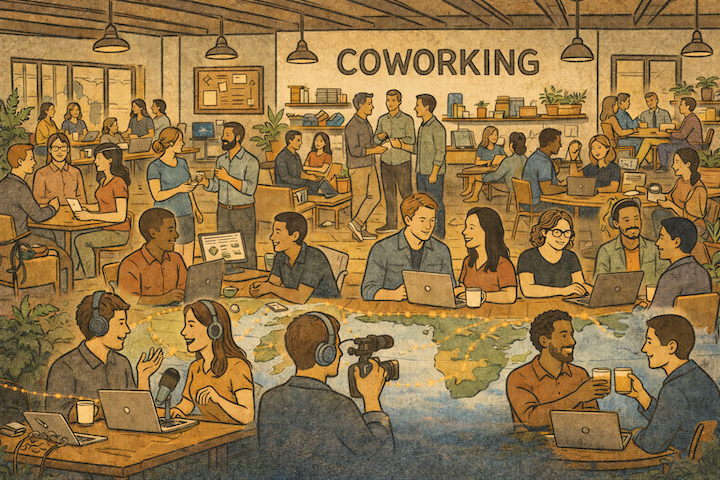
Coworking, at its best, isn’t just about gathering people who already think alike. It’s about creating space for cross-pollination: the designer meeting the nonprofit director, the founder learning from the freelancer, the executive collaborating with the entrepreneur, the newcomer being invited into the conversation instead of standing on the sidelines.
Bridging communities turn spaces into ecosystems and transform proximity into possibility.
What are You Building?
There’s a time and place for bonding communities. Not everything needs to be open to everyone. Depth matters. Trust matters. Shared experience matters.
But if you’re trying to build something expansive, inclusive, and future-focused in your coworking space, it’s worth asking: Are we building community that reinforces sameness or community that invites growth?
Because the most powerful coworking communities don’t just make people feel like they belong. They help people elevate their work and their lives. They are social capital superchargers. They are force multipliers.
So don’t wait for community to magically appear in your space, because it won’t happen. Be proactive, intentional, and communicative about what you’re building, who it’s for, and why you’re building it.
🧪 2025 helped clarify what coworking creators and community builders truly need. 2026 is where we deliver on it in a bigger way. See what we’re up to in the Coworking Creators Lab.