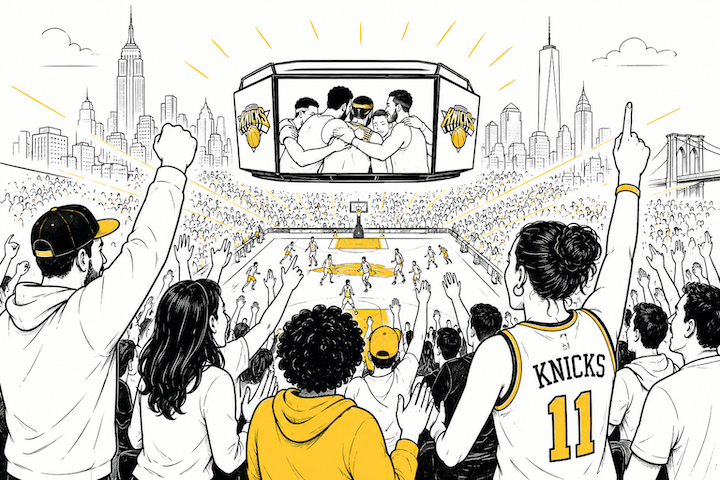
When the New York Knicks won their first NBA championship since 1973, New York City erupted.
Thousands of fans flooded the streets. Complete strangers hugged each other. Car horns echoed through the city long into the night. People climbed light poles, danced on sidewalks, and celebrated with a joy that felt impossible to contain.
But what struck me wasn’t just the championship celebration itself, it was how familiar everyone seemed. For one night, millions of people shared something powerful enough to erase the usual barriers between strangers.
They belonged to the same thing.
How Belonging Works
As someone who spends a lot of time thinking about belonging, I’ve been fascinated by the Knicks’ playoff run. The games and player storylines have been wildly entertaining, but the thing that really captured my attention was watching one of the world’s most effective belonging machines operate at full capacity.
The Knicks have provided a masterclass in how belonging works. Because people are searching for ways to belong and sports happen to be one of the most effective pathways to belonging ever created.
One reason sports fandom is so powerful is that there is no barrier to entry. Nobody interviews you before you become a Knicks fan. Nobody checks your credentials. Nobody asks how much money you make, or what neighborhood you live in. You simply decide you’re in.
Maybe you grew up in New York. Maybe your parents raised you on stories of Patrick Ewing and the battles of the 1990s. Maybe you fell in love with the team last month.
However it happens, the choice belongs to you. And people tend to feel more connected to identities they choose than identities imposed upon them.
The Knicks have also demonstrated something I think community builders sometimes forget: people don’t have to gather in the same place to feel connected.
Some fans watched games inside Madison Square Garden. Others gathered in bars, restaurants, parks, and living rooms. Watch parties sprang up across New York and far beyond. Millions more followed every possession from homes scattered around the world.
Participating in the Same Story
The experience was distributed, but the feeling was shared. And that distinction matters. We often confuse proximity with connection. But belonging is less about being in the same place and more about participating in the same story.
Sports also create an endless supply of small, low-stakes interactions that contribute to our sense of connection. You spot someone wearing a Knicks hat at the airport or notice a jersey at the grocery store, exchange a smile and a quick comment about last night’s game.
This type of belonging doesn’t begin with deep friendship, it begins with simply being seen.
Bigger than Basketball
The Knicks have become something bigger than a basketball team because they provide people with a shared identity. For many fans, supporting the team is an expression of pride in New York, a city that is resilient, ambitious, creative, diverse, and unapologetically itself.
Humans have always organized themselves around shared identities. Families, neighborhoods, religions, professions, clubs, nations, and teams all help answer one of our deepest questions: Who am I?
Sports offer a remarkably simple answer: I am a Knicks fan. And when enough people share that answer, a community emerges.
Shared Mythology
What I find particularly beautiful about sports fandom is that it creates space for people who might otherwise never cross paths. In the stands, at watch parties, and online, people from different generations, professions, cultures, and political beliefs gather around a common interest.
The community doesn’t require everyone to be the same, it simply requires everyone to care about the same thing.
And what a story it has been.
Championships in the 1970s, decades of heartbreak, near misses, false starts, legendary players, unforgettable moments, and the long wait for another title.
Every strong community develops a shared mythology. And over time, those stories become part of its culture. New members inherit them, old members pass them along. The stories become the bridge between generations. And the result is something larger than any individual player, coach, or owner.
Community Ownership
Which brings me to one of the most fascinating aspects of sports fandom: fans often feel a sense of ownership. Players come and go, coaches come and go, owners come and go, but the team remains. (Most of the time. RIP Seattle Supersonics.)
It belongs to the community in the same way the Knicks belong to New York.
That’s why victories feel personal. That’s why losses hurt. That’s why people who have never met each other can celebrate together in the streets. Because they aren’t simply consuming a product, they’re participating in a community.
And in a time when loneliness and isolation continue to rise, that participation matters.
The U.S. Surgeon General has called loneliness a public health crisis. Millions of people report feeling disconnected from those around them. Traditional sources of community have weakened in many places, leaving people searching for connection elsewhere.
Sports isn’t the whole solution, but it provides something many people desperately need: a reason to gather, a reason to talk, a reason to celebrate, and a reason to feel part of something larger than themselves.
And this sense of belonging isn’t limited by geography. The Knicks may represent New York, but their community extends far beyond the city. Fans across the country (and around the world) felt connected to this championship run.
Pathways to Belonging
Because beneath the jerseys, rivalries, statistics, and championships lies something much more human: a pathway to belonging.
And that’s the lesson for community builders.
Whether we’re creating coworking spaces, neighborhood groups, professional communities, churches, clubs, or online gatherings, the goal isn’t necessarily to build one giant community where everyone feels connected in the same way.
The goal is to create pathways that help people find each other, that help people feel seen, that help people participate, that help people become part of a shared story.
The Knicks didn’t just win a championship, they reminded millions of people what it feels like to belong.
🏀 Are you creating a space of belonging? Join us in the Coworking Creators Lab.