Hi friends,
Every year for Coworking Day, I write an open letter to the coworking world. You can read all my past letters here.
These letters tend to be love letters, with a little tough love mixed in. Having been in coworking for 14+ years, I take my role as storyteller, teacher, waypointer, and memory keeper very seriously as coworking catapults from a movement into a global industry.
This year, I want to acknowledge the elephant in the room.
Back in the day, coworking spaces were small and community was the goal. And I believe that community is still the goal. The best coworking spaces in the world are communities of people who know and support each other. This is the high bar.
And …
As spaces grow, brands grow, and the industry grows, having spaces where everyone knows everyone else is becoming more rare. Members hop around locations, teams move in and out, staff members churn, and having a single community for everyone is more elusive.
An operator recently told me they have 400 members and there is no way they can know all of them. Fair point. However, you may not know everyone, but everyone needs to know some people.
Every one of your members needs to feel seen, appreciated, and part of something meaningful.
Indie, community-focused spaces are really good at creating places of connection and belonging. It’s an unfair advantage you have over Big Coworking that you are naturally more nimble, locally engaged, collaborative, creative, and connected.
But I’ve seen many brands, indies included, start to lose the community magic of coworking as they scale. There are ways, however, to grow while also being a place of connection and belonging.
Here are a few ideas:
1. Create micro communities of shared interest. Connecting hundreds of people into a single community is a big lift. Connecting a handful, or a few dozen people into a community of shared interest is a lot more doable. These micro communities can be work-related (My Park City Marketing Club is a community of entrepreneurs and marketing pros), but they can also be formed around sports and outdoor activities, creating, reading, tech, entertainment, whatever.
2. Host low-stakes events. A recent Eventbrite study found that people want more soft-socializing events where the stakes are low, the networking awkwardness is nonexistent, creativity and fun vibes are high, and they can connect without it feeling like they’re being judged or on display. Think: crafting, Silent Book Club, watch parties, game nights, puzzle tables, etc.
3. Continue to facilitate connection and community at every touchpoint. Community is the goal, and community starts with people feeling a sense of belonging in your space. So make sure you’re introducing members, being curious about what people are working on, prioritizing connections over hospitality touches, and generally connecting with people on a human level. This is the seed of all great communities.
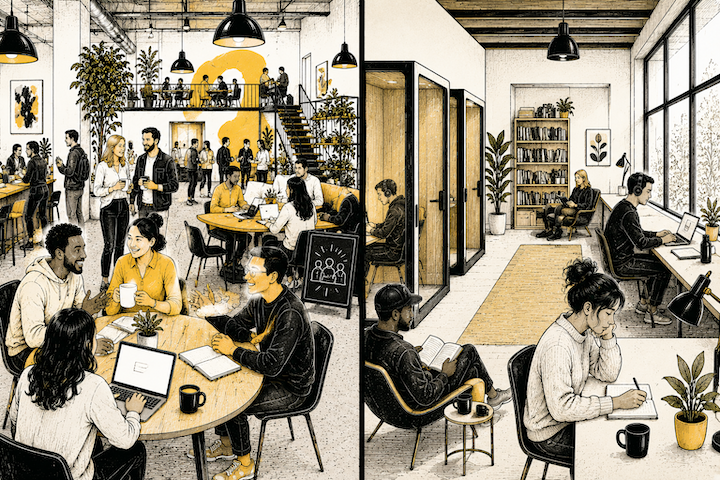
4. Focus on creating multiple pathways to belonging. In your space, you have extroverts, introverts, heads-down workers, creators, people with lots of schedule flexibility, people with no flexibility, social butterflies, working parents who need to pick up their kids, young people who would like to have more social interaction, and everyone in-between. Make space for all of your members to feel connected and part of the group.
Let me reiterate:
Having an engaged, connected, mutually supportive community is the high bar for coworking. Because the member experience in an activated and connected space versus one in which no one knows anyone is night and day.
If you think it’s lonely working from home, try working from a space where you know no one, talk to no one, and come home feeling more alone than before you went in. It reminds me of the John Prine song, “Angel from Montgomery:”
“How the hell can a person
Go to work in the morning
Then come home in the evening
And have nothing to say?”
Every one of your members needs to feel a sense of belonging in your coworking space.
Every single one.
But you can’t be the only point of connection and belonging for your members because:
a) You don’t have the bandwidth or emotional energy to be everyone’s coworking bestie.
b) If you are everyone’s coworking bestie, you’re a single point of failure. When you’re not there, no connection is happening.
So, this Coworking Day, as we continue to navigate the incredible growth and evolution of coworking, take a minute to reflect on how you’re doing when it comes to connection, community, and belonging. If you’re one of the spaces that already has a well-connected community of people who know and support each other, keep going! Keep pushing! Keep leading! High fives all around!
And if you’re finding that as you grow and scale, the community piece of your coworking space is getting a bit wobbly, double down on connection and belonging. Bring smaller groups of members together. Create multiple pathways to belonging. Focus on connection at every touch point. Make sure every member has points of connection.
Because simply being a shared workspace is not enough of a differentiator. The industry is growing too fast for that. The coworking teams who know who they are, who they serve, and how to be places of connection and belonging for members (and the extended community), are the future of coworking … and work.
Happy Coworking Day! And keep doing the good work.
Further together,
Cat
📬 This originally appeared in my weekly email, The Coworking Letter. Subscribe today to join 2500+ community-focused coworking pros who get the Letter every Thursday.