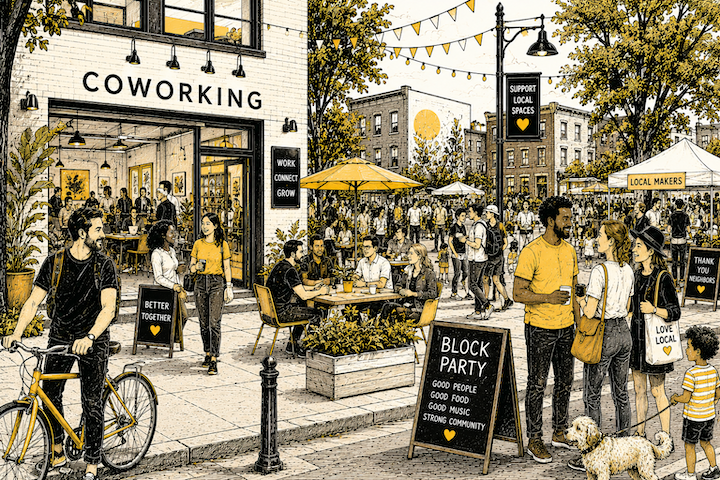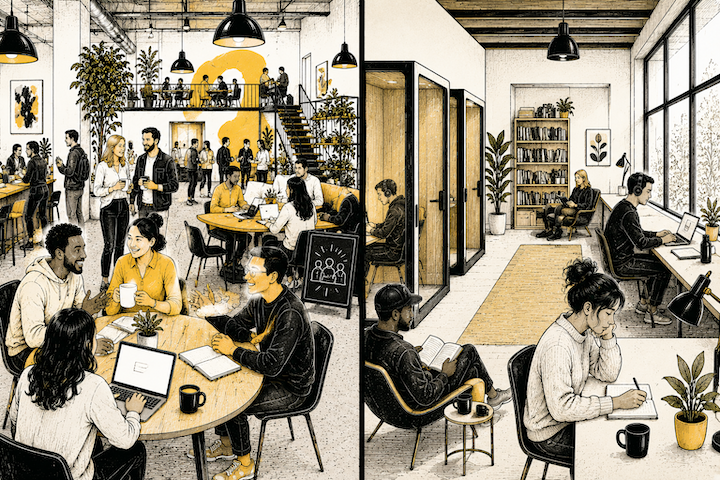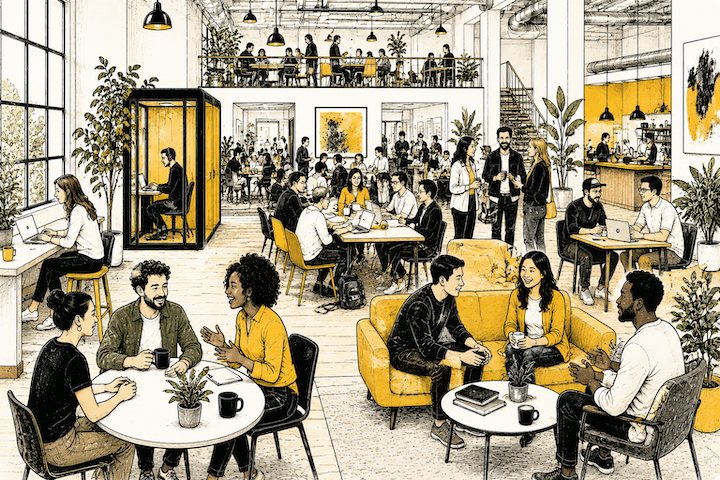
Community coworking is the evolution of workspace culture. It is a shift from renting desks and offices to cultivating connection and belonging. It is not a new twist on commercial real estate and office rental. It is something new, something fresh, something different.
I’ve been in coworking for more than a decade and my experience in community coworking spaces is so superior to my experience in office rental facilities that I don’t even consider them the same. Community coworking and boring office rental that has been around for ages are, in fact, exact opposites.
This guide is designed to help you better understand what community coworking is, and why it matters so you can create a coworking space and brand that makes a real difference in the work and lives of your members, and creates a real impact locally.
Let’s dive in.
What is community coworking?
Community coworking spaces turn work and workspace into community infrastructure designed for personal and professional growth. These community-focused spaces are rooted in humanness, local impact, and the belief that work is better when we do it together.
Community coworking is not a commercial real estate pivot, old-school office rental, boring and lifeless spaces, a group of professionals who work near each other but never interact, or one-off transactions.
Community coworking spaces are transformational versus transactional and have high levels of engagement, participation, collaboration and mutual support among their members. These inclusive spaces naturally make an impact in their neighborhoods, towns, regions, and extended local community.
Community is woven into the DNA of community coworking spaces and brands. It defines what the space will be and what the coworking brand represents. It is the driving force of connection and belonging and informs the norms and vibe of a coworking space.
Your Coworking Vision, Values and Vibe
Community coworking spaces have a clear vision, values, and vibe that they’re working toward. This means being clear on the change they’re working to create in the world, having stated core values that help define your space, brand, and business, and give your brand clear guidelines to refer to as you grow and evolve.
It also means creating a vibe in your space that doesn’t settle for people exchanging polite hellos or nods in the hallway, without any real connection or engagement. To create a coworking space with a great vibe, people need to be connecting and feel a sense of belonging. You need to be community-first. It simply won’t work to try to turn transactional relationships where customers rent desks and offices into a thriving community and space with a great vibe.
What is the definition of a coworking community?
Let’s start with the basics. What does community mean in a coworking space, what does it look like, and how does coworking build community?
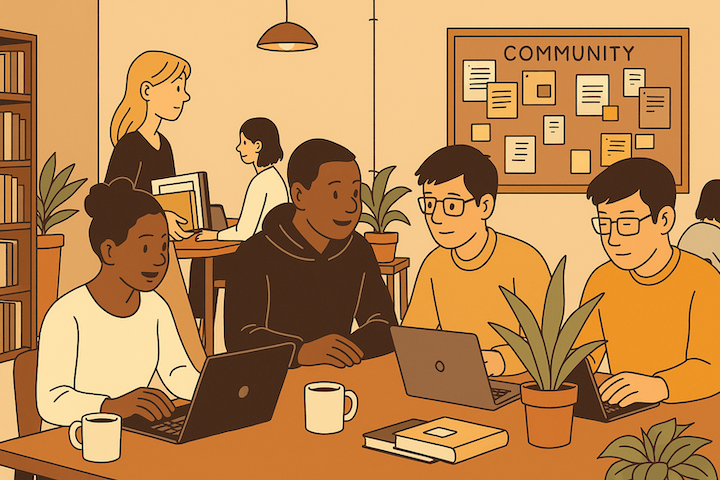
A coworking community is a group of entrepreneurs, freelancers, business owners, startups, and more who share workspace, meeting rooms, podcast rooms, phone booths, coffee machines, common spaces, kitchen areas, and everything else that makes a great workplace. But they don’t stop there. The best coworking communities are mutually supportive, collaborative, generous, rooted in the local community, hubs for professionals and creatives, and participating members of their neighborhood.
Why does community coworking matter?
It’s no longer news that we’re in a loneliness epidemic. Brought to light in 2023 by US Surgeon General Vivek Murthy, the loneliness epidemic has only gotten worse. Suicide rates are increasing, with over 49,000 people dying by suicide in 2023 in the US alone. That is one death every 11 minutes. An online-first world, phone addiction, and social trends have created a culture of isolation that is literally killing people.
We used to have a lot more ways for people to connect socially. My grandparents were members of their golf league, their local Elks Club, a bowling league, they regularly had poker nights, they attended church socials, they had dances, and more. On any given week, they were socializing two, three, four or more times. We have shifted from this community-focused life to one of isolation and insulation in the pursuit of entertainment, productivity and efficiency.
The result of this has heavy consequences for society. In his book Bowling Alone, Robert Putnam writes, “Serendipitous connections become less likely as increased communication narrows our tastes and interests. Knowing and caring more and more about less and less. This tendency may increase productivity in a narrow sense while decreasing social cohesion.”
And even work, which used to include more after-hours socializing and connecting, has shifted into something you do and then get back home as quickly as possible. I understand this mentality entirely. We’re in an era of wrecking ball layoffs and seemingly nonexistent loyalty between employer and employee. I also recognize that if we’re not connecting as humans at—and beyond—work, a massive amount of our time is collectively unfulfilling and uninspired.
This is where coworking comes in. Community coworking offers the best of workplace culture and connection, without the worst parts, like hierarchies, unnecessary commutes, bosses looking over your shoulder, cliques, and sitting in a lifeless room or cubicle all day.
Coworking spaces are, by design, flat—meaning they’re not hierarchical because everyone is there doing their thing, and you’re surrounded by other people doing their thing. Yes, there are teams in coworking space, but the overall vibe is the antithesis of cubicle life, where employees put in time, doing only what is absolutely necessary, until they can go home.
In contrast to this, community coworking spaces boost productivity, engagement, and even happiness. A study of coworking members by Emergent Research and GCUC found the following:
- 87% of respondents report that they meet other members for social reasons
- 54% say they socialize with other members after work and/or on weekends
- 79% said coworking has expanded their social networks
- 83% report that they are less lonely since joining a coworking space
- 89% report that they are happier since joining a coworking space
Why is coworking so effective? Here are eight reasons:
1. Coworking spaces are designed to help you do your best work on any given day. That means there are different zones and amenities for taking calls, having a meeting, working quietly, working in community spaces, etc. This flexibility to work in an area that works for you is a great way to stay engaged throughout the day, focus when you need to, connect when you’re able, and generally enjoy the work day more.
2. Coworking supports a flexible work schedule. Whether you’re an early bird with calls in different time zones, a night owl who programs into the wee hours, a 9-to-5er with a predictable schedule, or someone whose schedule changes every day or week, coworking can work for you.
3. The best coworking spaces are hubs of belonging. And community coworking spaces do this better than anyone. Belonging extends beyond just knowing how the coffee machine works or what the next events are. Belonging means you can bring your whole self to the space, you’ll be welcomed into the community as a friend, you can participate (or not) in ways that work for you, and it feels like your home away from home.
4. Coworking is a third place. Third places are those places that aren’t home and aren’t work. Coworking, while technically a workspace, goes far beyond that and is, ideally, a nice third place where members and the extended community can learn, share, and connect.
5. Coworking spaces are collaborative. Collaboration is a core part of coworking, going back to the earliest days. Members, whether freelancers, solopreneurs, business owners, startups, remote workers, teams, entrepreneurs, creatives, and everything in-between, can tap into a wealth and diversity of expertise, interests, and skillsets that naturally lend themselves to collaboration.
6. Coworking spaces are neighborhood hubs. The best coworking spaces have communities that extend far beyond the walls of their space. They are hubs for the neighborhood, town, region, and beyond. Having a robust extended community means more networking, more collaboration, and more opportunities for connection.
7. A great coworking space is designed for comfort, connection and elevated work. Members are in their home coworking space day after day, week after week, month after month, year after year. Stiff spaces that look good in photos but don’t actually function well on a day-to-day basis are not great coworking spaces.
8. Community managers and the coworking team are part of the coworking community. This is a key part of being a robust, engaged coworking community. The community managers don’t build community from above, or from beyond the circle of members, they build it with members. Community managers are an active, engaged part of a coworking community.
What is not community coworking?
To better understand community coworking, we have to clarify what it is not. Here are four examples:
1. Community coworking is not office rental. Office rental is nothing new. Even serviced offices, with a receptionist and coffee, is nothing new. These things have been around for decades.
2. Community coworking is not a real estate play. As commercial real estate occupancy rates plummet, landlords and tenants are turning to what they call “flex” as a way to fill vacant space. But creating a space with coffee, meeting rooms, and some couches does not make a community coworking space.
3. Community coworking is not transactional. There’s nothing wrong with transactional relationships. The gal who does my pedicure and I have a transactional relationship. We chat a little bit, but when I need a pedicure, she gives me a pedicure, and I pay her. Contrast this with my home coworking space, where I grow my business, chat with people throughout the day, partner on programming, am an engaged member of the community, help introduce new members around, etc. Community coworking is transformational rather than transactional.
4. Community coworking is not serviced offices, where the coffee, receptionist, phone answering services, and business address are included with your office. These spaces have their place, but they’re not community coworking spaces.

What does it mean to be a coworking community?
A coworking community is a mutually-supportive group of people who work in a shared workspace. Coworking communities can be large or small, they can be limited to one coworking space, or they can stretch across multiple coworking locations. Coworking communities can also include the extended local community that participates through programming, social events, and other offerings in the space.
The culture of coworking is rooted in collaboration and connection. Going back to the early days of coworking, coworking space members would share ideas, information, resources, experiences, and vision. This is still very much true in great coworking communities.
The value of a coworking community
The value of a coworking community is practically limitless. With a built-in professional network, a variety of professions and interests all in the same space, access to professional amenities and meeting spaces, the value of a coworking community and the coworking community culture is limited only by the involvement and imagination of the coworking members and team.
Examples of great community coworking spaces
Great community coworking spaces can be found around the world. Here are three examples of great community coworking spaces
The Candy Factory: Located in Lancaster, Pennsylvania, USA, The Candy Factory dubs itself a coworking space and social club. With a massive space with room for open mics and music events, workouts, art, performances, and more, as well as a robust and engaged community, and dozens of events per week, The Candy Factory is a standout community coworking space.
P30: P30 is located in the Far Eastside of Indianapolis, Indiana, USA. In this historically underappreciated and underserved area of town, P30 is on a mission to “rewrite the narrative alongside our community partners by disrupting inequality, igniting hope, and launching prosperity in the Far Eastside community of Indianapolis” through entrepreneurial training, opportunities for connection, and a collaborative and mutually-supportive coworking community.
Altspace: Located in Bansko, Bulgaria, Altspace Coworking is home to a thriving and ever-changing community of digital nomads and more. Recognizing that travelers frequently feel lonely and disconnected, Altspace focused on creating ways for digital nomads to connect, collaborate, and enjoy beautiful Bansko together.
7 Signs of a Thriving Coworking Community
Spaces that look nice but are devoid of energy are boring and uninspiring, which means members are already thinking of leaving for another space or back to their work-from-home or coffee shop life.
Which is no good for anyone.
Here are seven signs you have a thriving coworking space and community.
1. Your members connect without you
If you’re the only one making connections in your space, you’re a single point of failure. As soon as you’re not there, members go back to being strangers milling around. The best thing you can do to boost engagement in your space is to create a norm of introductions, and members connecting with people they haven’t met yet.
This starts on day one when you introduce your new member around to a number of members. Lauren Urlacher from Fellow Coworking shared a genius strategy that they onboard new members in the common space / kitchen so they can start meeting people immediately.
2. Your members do things without you
While it may sting just a little bit to see your members going off to do social things without you, this is actually a signal that your community is thriving. People using your space (and beyond) as a place of connection, collaboration, and friendship lets you know the vibe is right and engagement is happening.
3. Your members introduce themselves and each other
To build on number one, it sets such a nice tone when people who haven’t met yet introduce themselves and each other. This can happen at the coffee machine, during an event, when they’re sitting near each other, and anywhere else people tend to bump into each other. This norm can be strengthened by you by saying, “Hey Tom. Have you connected with Susan yet? Susan is project manager for a branding agency. Susan, Tom is an organic gardener working on creating a CSA.”
(Notice that the trick here is to know your members and what they’re working on. This is the cheat code to creating a great vibe. If you take an interest in your members and what they’re working on, your other members will do the same.)
4. Your members clean up after themselves
I know, I know. The dishes in the sink thing is enough to send you over the edge. If it eases the pain a bit, this is something coworking spaces around the world struggle with. Aaaaand, when members understand it’s their role as part of the community to clean up after themselves, you’re on your way to having collective buy-in and a sense of ownership of the space, which is the first step to having a sense of belonging in your community.
I talk about how if you act like a receptionist, you’ll be treated as a receptionist. Well, the same thing goes for clean-up. If you act like the clean-up staff, you will be treated as such.
5. Your members feel a sense of ownership and belonging in the space
As I mentioned, feeling a sense of ownership of the space is the quickest way to feel a sense of belonging in the community. So, how do you facilitate this? Ask your members to contribute to the space. It can be a plate of their famous cookies; teaching a lunch and learn; hosting a workshop for the community; playing guitar at the next happy hour; etc etc etc.
The point is that the more engaged a member is in bringing their whole self to the space, the more permission everyone has to do the same, which creates off-the-charts engagement and fun.
6. Your members celebrate wins together
Do you have ways for members to celebrate wins? Would the other members even know if someone just had a life changing moment, day, or event? Get creative with this one. Celebrate wins through your communication channels; have a “Wins Board”; put a little bell in the space that people can ring when something good happens. It doesn’t matter what the win is. In a great coworking community, a win for one is a win for all.
7. Your members support each other during hard times
On the flip side of celebrations, it’s equally important to have a sense of support and belonging on your worst day. It’s great to celebrate wins, but who better than other members, understands the frustrations and challenges of entrepreneurship, remote work, startups, running a business, and building something new?
A good way to bring members closer together and remove the pretending that everything is always great is to have Fail Fests, Fuckup Nights, Cry It Out channels (This is my favorite channel in the Coworking Creators Lab Slack). The veil separating us from each other is so very thin. It just takes a moment of humanness to create a real connection between people.
The Roots of Coworking
Coworking is deeply rooted in community, collaboration, connection, and mutual support. As laptops became mainstream, freelancers, startups, creatives, business owners, and remote workers were able to leave their desktop computers at home and work wherever there was wifi. They quickly found that working together is better than working alone.
In the early days of coworking, it was common to see pop-up coworking events at bars, public spaces, libraries, coffee shops, homes, wherever people could sit, connect, and work.
The people who pioneered this scrappy coworking movement proved the model—that, indeed, people would rather work in inviting, engaging, inspiring spaces, than at home alone. Once the model was proven, big money and what would become big brands such as WeWork, jumped on the coworking bandwagon and even went as far as doing predatory marketing and sales strategies, where they would park outside of existing coworking spaces and advertise free coworking if people moved to their spaces.
Lucky for all of us, community coworking survived the onslaught of big money (though plenty of small brands did go out of business), and is alive and well. In fact, the big coworking brands with deep pockets for advertising, expensive design, and discounted rates, increasingly look to community coworking spaces to see how to build community, engagement and a vibrant atmosphere in their spaces. As we community coworking pros like to say, “You can’t buy community, you have to build it.”
Coworking Values
In the early days of coworking, these coworking core values were put in place:
- Community
- Openness
- Collaboration
- Sustainability
- Accessibility
As coworking has grown, coworking leaders, spaces, and brands have created their own core values that align with their location and community, but many of these core values can be found across the coworking industry.
The Future of Coworking
The future of coworking will be built by young people moving into the industry, both as members, space operators, and industry pros. Where executive suites and traditional office rental are still around, the future of coworking is connected communities of people sharing space, ideas, collaborative energy, resources, and more.
Gone are the days where being an office rental facility was enough to stand out. In fact, being a coworking space is no longer enough to stand out. The coworking brands that will thrive in the future are less about the space itself and more about what happens in those spaces: the connections made, the careers elevated, the collaborations created, the ideas brought to life.
This is the future of coworking. And community coworking spaces are poised to lead the way into this future.
Next Steps
You’re working to build a coworking community. Here are three ways to learn, share, and connect with your peers:
1️⃣ Subscribe to receive The Coworking Letter weekly email, full of strategies and insights.
2️⃣ Register for the next Coworking Convo
3️⃣ Join the Coworking Creators Lab for community-focused spaces